
Why Leadership Begins Long Before Influence

For a long time, I thought leadership began when someone gave you something to lead.
A business. A team. A church. A nonprofit. Maybe just a handful of people who suddenly looked to you for answers you weren't entirely sure you had. I've had the privilege of leading all of those in one form or another, and looking back, I don't think that's where leadership began at all. By the time people start following you, much of the groundwork has already been laid. You bring yourself with you.
Your insecurities come along. So does your ego. Your relationship with money, your need for approval, the way you respond when somebody disagrees with you, whether you can admit you're wrong, how much of your identity is wrapped up in being successful. All of that walks into the room with you.
So do the good things, of course. The patience you've developed. The ability to listen. The discipline to do what you said you would do. The willingness to make a difficult decision and live with it. The humility to recognize that the person across the table may see something you don't.
A title doesn't create any of that... It just gives it somewhere to show up.
I learned more about leadership from getting it wrong and I've spent a good portion of my life building things. Businesses, churches and nonprofits. Projects I believed in deeply and a few ideas that probably weren't quite as brilliant as I thought they were at the time.
When you're younger, it's very easy to think leadership is mostly about getting people moving in the same direction. You cast the vision, make decisions, solve problems and keep things moving forward. And yes, that's part of it. But after you've done it for long enough, you begin to notice that many of the hardest leadership problems aren't really sitting around the conference table. They're sitting in you.
I can think of decisions I made because they were genuinely the right decisions. I can also think of decisions that were probably influenced more than I'd like to admit by pride, fear, impatience or the need to prove something. It's much easier to see the difference looking backward.
That's one of the uncomfortable things about leadership. People can only respond to the decision you make. You're the one who has to be honest about where it came from. Success gives you a bigger microphone... We often talk about success as though it changes people. I'm not convinced it always does. I think it often gives people more freedom to become publicly what they were already becoming privately.
If you need everyone to like you, greater responsibility doesn't magically make that disappear. Now you simply have more people whose approval you're trying to keep. If your identity depends on achievement, a bigger business won't satisfy it for very long. The target moves. If you avoid conflict, having a larger team gives you more difficult conversations to avoid.
If you believe everything depends on you, success can be particularly dangerous because for a while the results may actually reinforce that belief. You work harder, carry more, solve everything yourself and people praise you for being committed.
Until something gives.
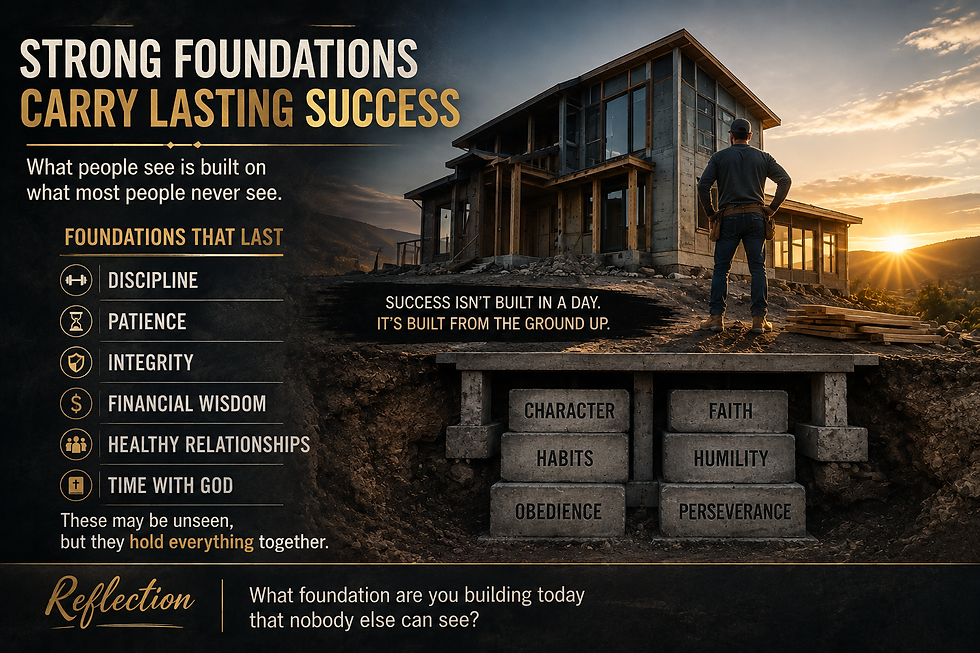
I've seen that happen to good leaders. I've felt pieces of it myself. This is why I think we make a mistake when we treat leadership development as something that becomes important once someone reaches a certain level. The inner work should have started years earlier.
Who are you becoming while you're busy getting there? That's a question I find myself asking more these days. Not simply, What am I building? Who am I becoming while I build it? There is a difference.
You can build something impressive while becoming impatient, absent, exhausted and increasingly difficult to live with. You can win professionally while quietly losing your marriage. You can become the person everyone calls for advice while having nobody in your own life who is allowed to tell you the truth. You can talk about the importance of people while treating your family as though they'll always understand why you aren't there.
And you can spend years telling yourself that this is just a busy season. That's one I've become particularly suspicious of. Life seems to contain an extraordinary number of “busy seasons” if we're willing to keep calling them that. Self-leadership isn't very glamorous, nobody puts “learned to control my ego” on LinkedIn.
There aren't many awards for becoming a better listener, changing your mind when you're wrong or learning that you don't need to have an opinion on everything. Yet those things matter enormously once other people are affected by who you are.
Can you sit with criticism long enough to find the part that's true? Can you make an unpopular decision without becoming defensive? Can you apologize without explaining why the other person was also wrong? Can you stop working when there is still work to be done? Can you celebrate somebody who is better than you at something? Can you let them be better? Can you say, “I don't know”?
Those aren't management techniques. They're signs of what's happening inside a person. And no leadership book, operating system or management framework can do that work for us.
I don't think good leadership requires having everything figured out. If that were the qualification, I'd have been disqualified a long time ago. But I do think leadership asks us to pay attention to the person doing the leading. That's where I've changed my mind over the years. I used to be much more interested in what people could build, how quickly they could grow it and whether they could get others to follow them.
These days I'm more interested in what the building is doing to the builder. Is your success making you more generous or more protective? Are you becoming more present or more distracted? Are the people closest to you getting the best of you, or whatever happens to be left? Do you still know why you're doing all of this? And if you eventually get everything you're working toward, will you like the person who gets there? Those questions matter long before somebody calls you a leader.
Because eventually the title may come. The company may grow. More people may start listening. Your decisions may carry more weight than they used to. When that happens, influence won't suddenly turn you into someone worth following. It will reveal a great deal about the person you've been becoming all along.
Perhaps that's where leadership really begins... Long before the title, long before the influence and long before anyone is watching.


Comments